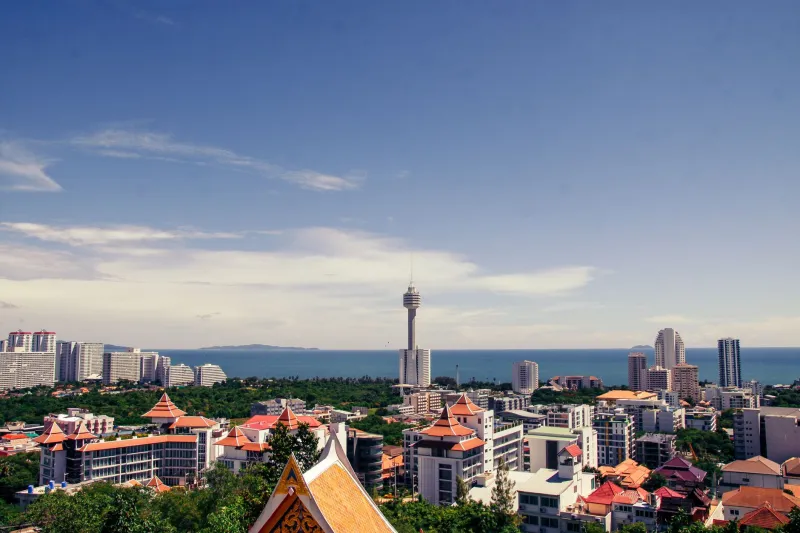
Building in the Tropics: How American Founders Are Launching Real Companies From Pattaya

The Office With a Sea View Nobody Talks About
Somewhere between the rooftop co-working spaces and the surprisingly fast fiber connections, Pattaya has started attracting a different kind of visitor. They're not here for a two-week vacation. They're here to build companies.
American founders — solo operators, two-person technical teams, even small funded startups — are quietly relocating to Pattaya and using it as a base to launch, iterate, and scale. It's not making TechCrunch headlines yet, but the conversations happening at places like HUBBA Pattaya or the business lounges in Central Festival are hard to ignore.
So what's actually drawing founders here, and does it hold up once the novelty wears off?
The Burn Rate Argument Is Real
Let's start with the obvious. Building a startup in San Francisco, Austin, or New York is brutally expensive before you've written a single line of code or closed a single customer. Rent, health insurance, hiring, even basic office space — it all stacks up fast and eats runway alive.
In Pattaya, the math flips. A furnished one-bedroom in a quality condo near Pratumnak Hill or Jomtien Beach runs $400–$700 a month. Coworking day passes cost $5–$15. A solid sit-down lunch is $3. Founders who previously needed $8,000–$10,000 a month just to survive in a US metro are suddenly operating on $2,500–$3,500 — and banking the difference into product development or their next hire.
For bootstrapped founders, that's not a lifestyle upgrade. That's a fundamentally different company trajectory.
The Southeast Asia Market Access Nobody Mentions
Here's what the burn rate conversation misses: Pattaya isn't just cheap. It's positioned. Thailand sits at the center of a 680-million-person regional economy that American companies chronically underestimate and underserve.
Founders building in fintech, e-commerce logistics, EdTech, or B2B SaaS for emerging markets are finding that being physically present in Southeast Asia changes how they understand their customers. The time zone alone — UTC+7 — makes syncing with clients and partners across Vietnam, Indonesia, Malaysia, and the Philippines dramatically easier than trying to coordinate from the US East Coast.
Several founders who've made the move describe a similar turning point: a product insight they simply wouldn't have had from a San Francisco apartment. Being here, surrounded by the actual infrastructure and consumer behavior of a rapidly digitalizing economy, makes product decisions sharper.
Visa Reality: What Business Owners Actually Do
This is where things get nuanced, and it's worth being direct. Thailand doesn't have a startup visa in the traditional sense — not the way Portugal or Germany do. What it has is a patchwork of options that founders are using creatively.
The Thailand Elite Visa (now rebranded under the Thailand PRIVILEGE program) gives long-term residency for a one-time fee and is popular with founders who want stability without the complexity of a business visa. The LTR (Long-Term Resident) Visa, launched in 2022, specifically targets remote workers and high-income professionals earning above certain thresholds — it's increasingly the go-to for founders with demonstrable income.
For those actually registering a Thai business entity — which some do to hire local staff or access BOI (Board of Investment) incentives — a Non-Immigrant B visa tied to the company is the standard route. The BOI route in particular is worth exploring for tech startups; Thailand's government has been actively courting digital businesses with tax exemptions and streamlined work permit processes.
None of this is as plug-and-play as it sounds. You'll want a local lawyer. Budget $500–$1,500 to get set up properly, and treat it as a business expense, not an inconvenience.
The Ecosystem: Smaller Than You Think, More Useful Than You'd Expect
Pattaya isn't Bangkok. The startup ecosystem here is genuinely small — a few hundred serious operators at most, not a few thousand. There's no Y Combinator demo day equivalent happening at a Pattaya beach club.
What there is, though, is a tight-knit group of builders who are unusually accessible. In San Francisco, getting 30 minutes with someone who's built and sold a SaaS company requires a warm intro and a three-week wait. In Pattaya, it happens over coffee at a beachside café on a Tuesday afternoon. The density of experience per square kilometer of social interaction is surprisingly high.
Monthly meetups, informal Slack communities, and a handful of active Facebook groups have created a loose but functional network. It's not a replacement for Silicon Valley's institutional support — there's no local venture capital, no accelerator pipeline — but for founders who are pre-seed or bootstrapped, the peer network punches above its weight.
The Pitfalls Nobody Posts About
It would be dishonest to skip the friction. Some of it is practical: banking remains a genuine headache for foreign-registered businesses, and getting a Thai business bank account without a local partner can be a months-long ordeal. US banking apps often flag Thai IP addresses for fraud. PayPal and Stripe have limitations in Thailand that will catch you off guard.
There's also the distraction factor. Pattaya is a city designed, in many ways, for pleasure. Founders who thrive here tend to be self-directed and disciplined. Those who need an office culture to stay accountable sometimes find the freedom destabilizing rather than liberating.
And then there's the perception issue back home. Some US investors and enterprise clients still raise an eyebrow at a Thai address on a pitch deck. It's fading as remote-first becomes normalized, but it hasn't disappeared entirely.
Who This Actually Works For
The founders who seem to get the most out of building in Pattaya share a few traits. They're usually post-validation — they've proven a concept and are in execution mode, not still searching for product-market fit. They're comfortable with async communication and have already built remote-capable workflows. And they're genuinely curious about Southeast Asia, not just using it as a backdrop for a cheaper version of their American life.
If that's you, Pattaya is a genuinely compelling place to build. The overhead is low, the lifestyle is high, and the market access is real. You just have to be honest with yourself about what kind of founder you are before you book the flight.