Do You Actually Need to Learn Thai? An Honest Answer for Americans in Pattaya

Photo by Photo by Helena Lopes on Unsplash on Unsplash
Here's a question you'll hear debated at every expat gathering in Pattaya, usually with surprising heat: Do you actually need to learn Thai?
The "no" camp makes a compelling case. Pattaya is extraordinarily English-accessible. Hotel staff, hospital receptionists, restaurant servers on Walking Street, real estate agents, Grab drivers—a functional English interaction is available at nearly every turn. Americans have lived here for years, even decades, operating almost entirely in English and getting along just fine.
The "yes" camp points to something harder to quantify. There's a version of Pattaya that exists behind the English-language interface—a richer, more authentic, more connected experience that only opens up when you can communicate directly with the people who actually live here. Language, they argue, isn't just a tool for transactions. It's the key to belonging.
Both camps are right. Which is what makes this conversation interesting.
Where English Gets You Through (Almost Everything)
Let's be honest about the baseline. If you're an American spending a few weeks or even a few months in Pattaya, you will not be meaningfully limited by speaking only English. The city's economic infrastructure has been built around international visitors for decades, and English proficiency among service workers and professionals is notably higher here than in most Thai cities.
International hospitals have dedicated English-speaking patient coordinators. Major shopping centers like Central Festival and Terminal 21 Pattaya have staff who can assist in English. Immigration offices—while not always comfortable experiences—have English-language forms and usually at least one officer who can communicate in basic English. Real estate agents catering to expats are almost universally English-fluent.
For digital nomads especially, the English layer of Pattaya is thick enough to live within indefinitely. Co-working spaces, expat Facebook groups, international restaurants, English-language banking assistance at major branches—the infrastructure exists specifically because so many people have done exactly this.
Where Thai Suddenly Matters Enormously
And then there are the situations where the English layer evaporates, and you feel its absence immediately.
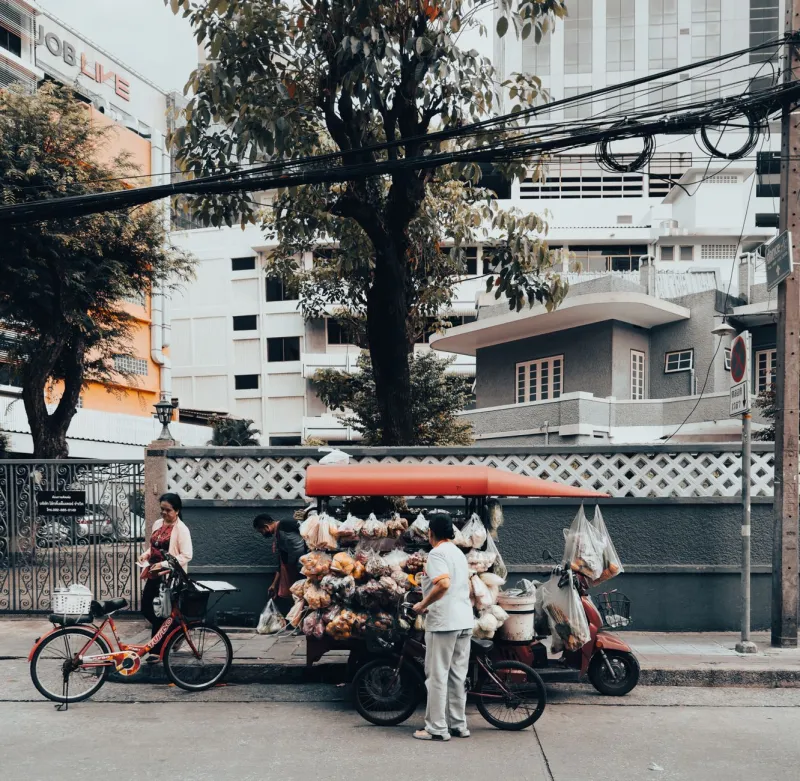
Local markets. Not the tourist-facing night markets on Beach Road, but the morning wet markets where residents actually buy their food. The vendors here often speak little to no English, prices aren't labeled, and the entire transaction runs on a combination of pointing, guessing, and goodwill. It works, after a fashion. But a handful of Thai phrases—numbers, basic food vocabulary, polite particles—transforms the experience from mildly awkward to genuinely enjoyable.
Medical emergencies with local clinics or ambulance services are another situation where Thai proficiency (or its absence) has real consequences. International hospitals have English support, but smaller clinics, pharmacies in residential neighborhoods, and emergency situations involving local responders often don't. Having even basic Thai in those moments isn't a nicety—it's a safety consideration.
Landlord relationships are a subtler but significant example. Many expats rent directly from Thai landlords rather than through international agencies. Those relationships, maintained entirely through translation apps and broken English, function at a surface level but rarely deepen. Landlords who can talk to their tenants directly—even imperfectly—tend to be more responsive, more flexible, and more personally invested in the arrangement.
And then there's the police. If you're ever involved in a traffic incident, a dispute, or any situation requiring official interaction at a local station rather than through an expat-facing channel, Thai fluency or lack thereof has very direct practical consequences.
What Long-Term Expats Wish They'd Known
Conversations with Americans who've been in Pattaya for five, ten, fifteen years reveal a consistent thread of retrospective advice about language—and it's not what you might expect.
Almost none of them say they wish they'd become fluent before arriving. Thai is a tonal language with no Latin-alphabet roots, and achieving real fluency requires years of dedicated effort. The advice isn't "learn Thai or you'll struggle." The advice is more specific.
"Learn enough to be polite," is how one 12-year Pattaya resident from California put it. "Sawadee krap, khob khun krap, mai pen rai—just the basics of showing respect. Thais notice immediately when a foreigner makes that effort, and it changes how they treat you."
This is more significant than it sounds. Thai culture places considerable value on social harmony and mutual respect, and the concept of kreng jai—a kind of considerate deference to others' feelings—shapes many interactions. A foreigner who approaches Thai people with visible effort to engage in their language, however broken, signals something important: you're not just passing through. You're trying to be here, not just in it.
Several long-term expats described a specific turning point—a moment when a Thai neighbor, landlord, or regular restaurant owner responded to their halting Thai with a kind of warmth that no English transaction had ever produced. "It's like a door opens," said one woman from Chicago who's been in Pattaya for seven years. "And you realize how many doors have been closed."
The Decision and What It Actually Shapes
The language question in Pattaya isn't really about survival or logistics. Those work fine in English. It's about what kind of experience you want to have here.
If Pattaya is a comfortable, well-appointed base of operations—a place where you work, exercise, eat well, and enjoy the climate while maintaining a life oriented primarily toward other expats and English-language culture—then deep Thai proficiency is genuinely optional. Plenty of people live this way and find it satisfying.
If you want Pattaya to become something more—if you want to understand the city rather than just inhabit it, to have real relationships with Thai people rather than pleasant service interactions, to feel at home rather than perpetually foreign—then language matters. Not fluency necessarily. But effort. Consistent, visible, humble effort to meet people in their language.
The paradox is that Pattaya's English-friendliness makes it easy to avoid that effort indefinitely. And that ease, for some people, quietly becomes the thing they regret most about their time here.
As one expat put it with characteristic bluntness: "I spent four years here before I learned to say anything more than 'hello' and 'thank you.' Then I spent six months actually studying. I got to a conversational level that's pretty basic, honestly. But Pattaya felt like a completely different city. I'm still a little angry at myself for waiting so long."